Cyprus R&D Super-Deduction: How the 120% Deduction Works and Which Businesses Should Use It
Cyprus offers a 120% tax deduction on qualifying R&D expenditure until 31 December 2030. Combined with the IP Box regime, it delivers an effective 3% tax rate on IP income. Here's how it works.
Written by Andreas AchilleosFinancial Advisory Lead · CFA Charterholder

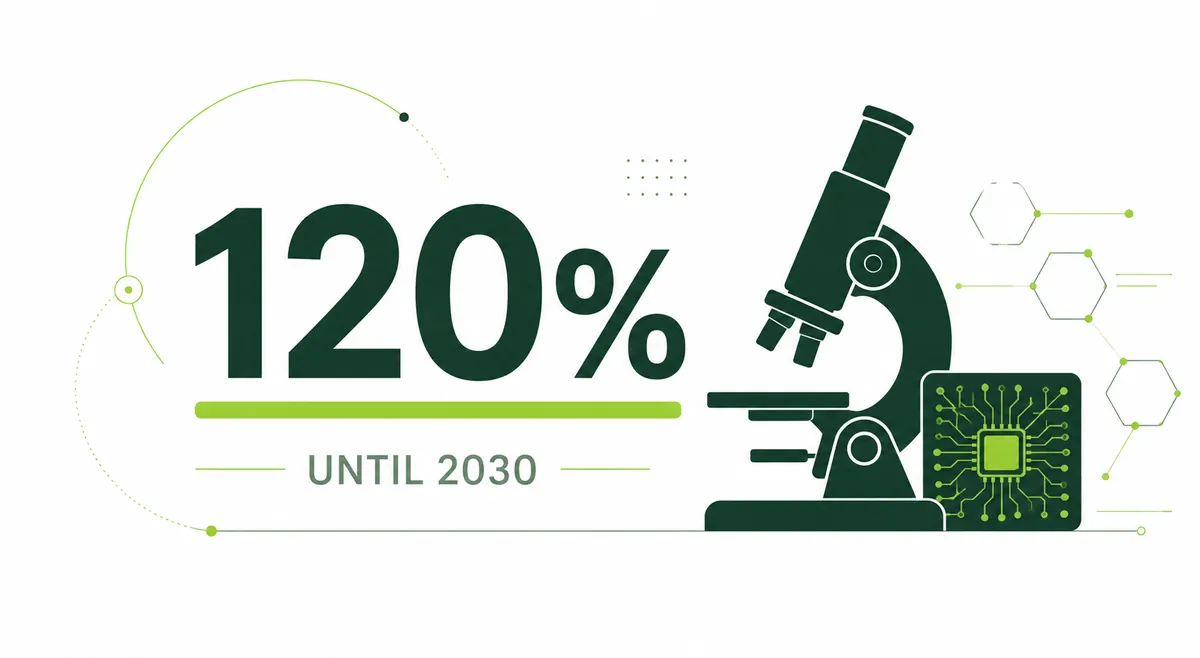
Cyprus allows a 120% tax deduction on qualifying research and development expenditure – meaning for every €100 spent on eligible R&D, €120 is deducted from taxable income. Available until 31 December 2030, the super-deduction is designed to incentivise genuine R&D activity in Cyprus and works most powerfully when combined with the IP Box regime (IP Box Regime) to achieve an effective tax rate of 3% on the resulting IP income.
What the 120% Deduction Means
A standard tax deduction allows a business to deduct 100% of an allowable expense – a EUR100 cost reduces taxable income by EUR100. The R&D super-deduction goes further: a EUR100 qualifying R&D cost reduces taxable income by EUR120, generating a tax deduction on EUR20 that was never actually spent.
At the 15% corporate tax rate (Tax Rate Article):
- Without super-deduction: €100 R&D spend → €100 deduction → €15 tax saving
- With super-deduction: €100 R&D spend → €120 deduction → €18 tax saving
The additional 20% uplift increases the after-tax value of R&D investment.
Worked Example: €500,000 R&D Spend
A Cyprus technology company spends €500,000 on qualifying R&D in 2026.
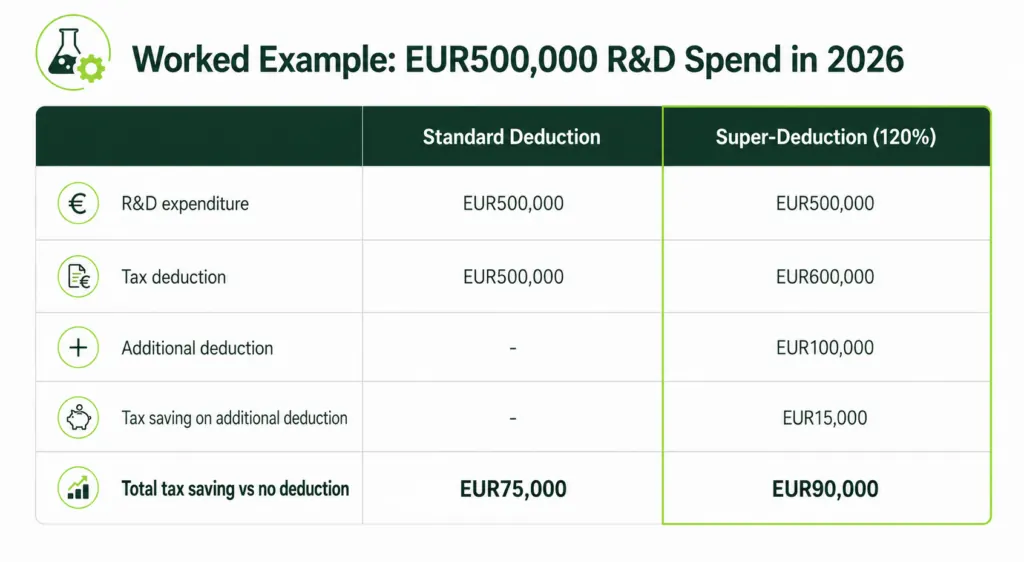
The super-deduction is worth an extra €15,000 in tax savings on €500,000 of R&D spend. The absolute saving scales with the amount invested.
What Qualifies as R&D Expenditure
The super-deduction applies to qualifying R&D costs – costs incurred in connection with research and development activities conducted for the purposes of the business.
Qualifying Costs
- Staff costs directly attributable to R&D activities – salaries, employer Social Insurance, and GHS for employees engaged in qualifying R&D
- Consumables and materials used in R&D projects
- Contracted R&D commissioned from unrelated third parties
- Software costs directly used in the conduct of R&D activities
- Overheads attributable to R&D on a reasonable allocation basis
What Does Not Qualify
The super-deduction does not apply to:
- Routine product development or incremental improvement – work that does not involve scientific or technological uncertainty does not constitute R&D
- Marketing research, customer surveys, or feasibility studies not involving scientific method
- Capital expenditure on buildings, equipment, or infrastructure
- R&D costs paid to related parties – contracted R&D must be with unrelated parties to qualify
- Commercial production or pre-production activities
The distinction between qualifying R&D and ineligible development work is a documentation and classification challenge. The Tax Department expects contemporaneous records – not post-hoc reclassification.
Documentation Requirements
To support a super-deduction claim, the company should maintain:
- Project-level R&D records – what was the scientific or technological objective? What uncertainties were being investigated?
- Cost allocation schedules – which staff were engaged on R&D and for what proportion of their time? How were materials allocated to qualifying projects?
- Timesheets or activity logs for staff whose time is being claimed
- Contractor agreements and invoices for externally commissioned R&D
- Outcome records – what was achieved or learned from the R&D activity, whether successful or not
Documentation does not need to be elaborate – but it needs to exist and be contemporaneous. A well-maintained project log and time-allocation record is sufficient for most SME-scale R&D claims.
The R&D Super-Deduction and IP Box Combined
The most powerful use of the super-deduction is as part of a two-stage Cyprus IP strategy.
Stage 1 - Develop
The Cyprus company undertakes qualifying R&D to develop intellectual property (software, a patent, a novel technical process). The R&D costs are deducted at 120%, reducing the net cost of the development.
Stage 2 - Exploit
The IP created is exploited – licensed to related or third parties, or embedded in products sold commercially. The income qualifies for the IP Box regime (IP Box Regime), which provides an 80% exemption, reducing the effective tax rate to 3%.
Illustrative Combined Effect
A company spends EUR1,000,000 developing a software product over two years. The product then generates EUR2,000,000 in annual licensing revenue.
R&D Phase:
- €1,000,000 R&D spend
- Super-deduction: €1,200,000
- Tax saved (vs no deduction): €180,000 (at 15%)
- Net after-tax cost of development: €820,000
Exploitation Phase (annual):
- €2,000,000 licensing income
- 80% IP Box exemption: €1,600,000 exempt
- Taxable: €400,000 at 15% = €60,000 tax
- Effective rate: 3%
The combination dramatically reduces both the upfront cost of creating IP and the ongoing tax cost of exploiting it.
Who Should Use the Super-Deduction
The R&D super-deduction is relevant for:
- Software and technology companies developing proprietary products in Cyprus
- Pharmaceutical and life sciences groups with active R&D programmes
- Industrial and engineering businesses investing in process innovation
- Any business that can credibly document qualifying R&D activity and is seeking to maximise the tax efficiency of that investment
It is not relevant for businesses whose costs are entirely commercial (sales, marketing, distribution) or whose product development is routine and incremental rather than research-driven.
Businesses using Cyprus as an IP holding and development hub can further enhance the structure through Cyprus’s double tax treaty network (Double Tax Treaties), which reduces withholding tax on royalties paid from overseas subsidiaries.
Availability Until 2030
The super-deduction is explicitly time-limited – it applies to qualifying expenditure incurred up to 31 December 2030. The super-deduction was introduced as part of the broader Cyprus Tax Reform 2026 package (Cyprus Tax Reforms).
Businesses with R&D investment plans extending beyond 2030 should model the impact of the deduction reverting to 100% after that date, and consider whether accelerating qualifying spend before the deadline is commercially appropriate.
There is no indication at this stage that the super-deduction will be extended beyond 2030, though the policy landscape may change.
Interaction with Pillar Two
For multinational groups with consolidated revenue above EUR750 million, Pillar Two (the OECD global minimum tax) requires a minimum effective tax rate of 15% globally. The combined use of the R&D super-deduction and IP Box can reduce the effective rate on specific income streams below 15%, which may trigger a top-up tax calculation under Pillar Two.
For the vast majority of businesses using these incentives – which operate well below the €750 million threshold – Pillar Two does not apply and the full benefit of both regimes is available without restriction.
For tailored advice on qualifying for the R&D super-deduction and structuring an IP strategy in Cyprus, contact Fiscalpoint at fiscalpoint.com.
This article is general information on Cyprus tax rules, not advice on your position. The right answer depends on your structure, your residency and the type of income, so treat it as the start of a conversation rather than the end of one.