Cyprus Non-Domicile Tax Status: Who Qualifies, What Taxes Are Exempted, and How Long It Lasts
Cyprus non-dom status exempts qualifying residents from SDC on dividends, interest, and rental income. Learn who qualifies, what the 17-year rule means, and how the 2026 extension works.
Written by Andreas AchilleosFinancial Advisory Lead · CFA Charterholder

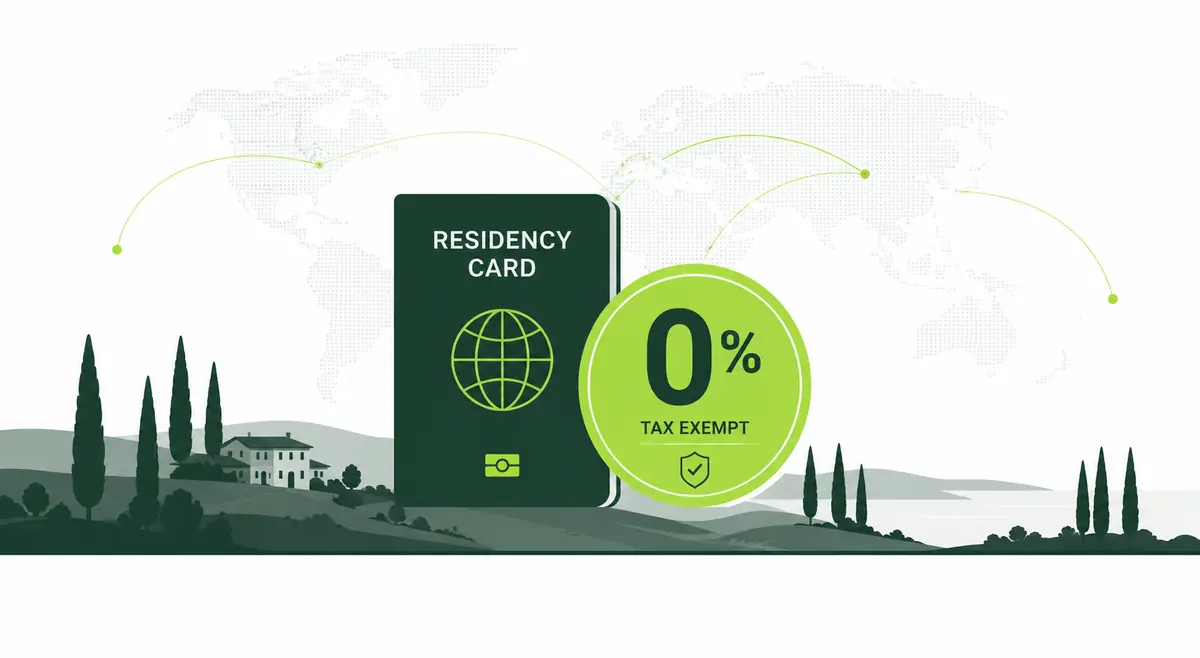
The Cyprus non-domicile (non-dom) regime exempts qualifying individuals from Special Defence Contribution on dividend, interest, and rental income – regardless of where in the world that income is sourced. For business owners, investors, and high-net-worth individuals relocating from high-tax jurisdictions, non-dom status combined with Cyprus tax residency is one of the most compelling personal tax planning positions available in the EU.
What Is Domicile Under Cyprus Law
Domicile is a separate legal concept from tax residency. You can be a Cyprus tax resident without being Cyprus domiciled – and that distinction is what the non-dom regime turns on.
Cyprus law recognises two forms of domicile:
- Domicile of origin: The domicile acquired at birth, typically from the father. A person born to a Cyprus-domiciled father acquires a Cyprus domicile of origin.
- Domicile of choice: Established when an individual settles in Cyprus with the intention of residing there permanently or indefinitely.
A person is not Cyprus domiciled if they were born elsewhere and have not established a Cyprus domicile of choice. Most foreign nationals relocating to Cyprus fall into this category – they become Cyprus tax residents but retain a non-Cyprus domicile.
There is also a rule by duration: an individual who has been a Cyprus tax resident for 17 out of the preceding 20 years is deemed to be Cyprus domiciled, regardless of their actual domicile status.
Who Qualifies as Non-Dom
An individual qualifies as non-domiciled in Cyprus if:
- They have a domicile of origin outside Cyprus, and
- They have not established a Cyprus domicile of choice, and
- They have not been a Cyprus tax resident for 17 of the preceding 20 years
This means a UK national, a German citizen, a US person, or an individual from any non-Cyprus background who relocates to Cyprus and establishes tax residency will typically qualify as non-dom from day one.
What SDC Exemptions Apply to Non-Doms
Non-domiciled Cyprus tax residents pay zero SDC on:
- Dividend income – from Cyprus companies, foreign companies, or any other source
- Interest income – from bank deposits, bonds, loans, or any other interest-bearing instrument
- Rental income – from Cyprus or foreign properties
For comparison, Cyprus-domiciled tax residents pay 5% SDC on dividends (reduced from 17% in 2026 – see our SDC Cyprus 2026 changes article: https://fiscalpoint.com/corporate-tax/sdc-cyprus-2026-changes/), 30% SDC on interest, and previously 2.25% on rental income (now abolished).
This is a particularly powerful benefit for individuals whose wealth is held in investment portfolios generating dividends and interest, or business owners receiving dividend distributions from their companies.
Comparison: Non-Dom vs UK Resident
A business owner receives EUR300,000 in dividends from their company in 2026.
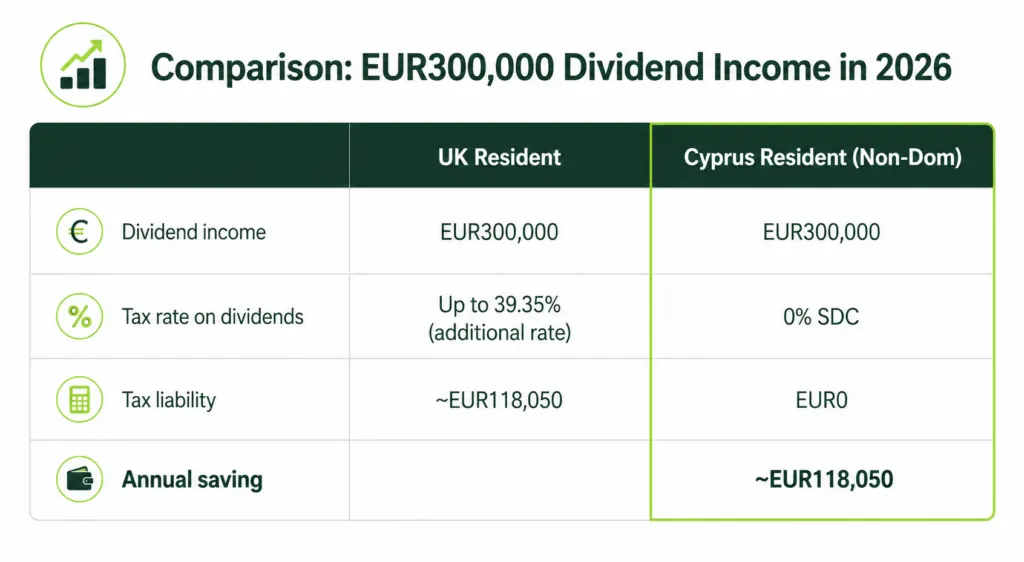
Income tax at the personal level does not apply to dividends in Cyprus – dividends are exempt from income tax entirely. SDC is the only levy, and non-doms are exempt from it.
The 17-Year Rule
Non-dom status is not permanent. An individual who has been a Cyprus tax resident for 17 of the preceding 20 years is deemed to have acquired Cyprus domicile and SDC exemptions cease.
For most non-doms who relocate to Cyprus in adulthood, this is a long runway – 17 years of SDC-free dividend, interest, and rental income. In practice, many individuals reach this threshold and then reassess their situation.
The 2026 Extension: Paying to Extend Non-Dom Status
The 2026 tax reform (Tax reforms) introduced a new option for individuals approaching or reaching the 17-year threshold. After completing 17 years of Cyprus tax residency (and therefore becoming deemed Cyprus domiciled), an individual can elect to extend their non-dom status for a further 5 years by paying a lump sum of EUR250,000.
This extension can be applied twice – meaning a maximum of 10 additional years of non-dom status beyond the 17-year point, in exchange for EUR500,000 total in lump sum payments.
When This Makes Sense
The lump sum extension is worth evaluating where the annual SDC saving exceeds the cost of the payment. For an individual with EUR2 million in annual dividends:
- SDC at 5% (for a domiciled resident): EUR100,000 per year
- Cost of 5-year extension: EUR250,000
- Break-even: 2.5 years
Over a full 5-year extension, the SDC saving would be EUR500,000 against a EUR250,000 lump sum – a net benefit of EUR250,000 before considering the interest cost of the payment.
The calculation changes depending on the individual’s income level, the types of income involved (interest attracts 30% SDC for domiciled residents, making the saving even larger for interest-heavy portfolios), and the opportunity cost of the lump sum.
How to Establish Cyprus Tax Residency as a Non-Dom
Non-dom status requires Cyprus tax residency. There are two routes:
The 183-Day Rule
The standard rule: spend more than 183 days in Cyprus in a calendar year. No other conditions apply.
The 60-Day Rule
A more flexible alternative for internationally mobile individuals. An individual qualifies as a Cyprus tax resident under the 60-day rule if:
- They spend at least 60 days in Cyprus during the tax year
- They are not tax resident in any other country in that year (i.e. do not spend more than 183 days in any single other country)
- They are not tax resident elsewhere under that country’s rules
- They have a business activity, employment, or directorship in Cyprus
- They maintain a permanent residence in Cyprus (owned or rented)
The 60-day rule is designed for individuals who divide their time across multiple jurisdictions. It enables Cyprus tax residency – and therefore non-dom status – with a relatively modest physical presence.
What Non-Dom Status Does Not Cover
Non-dom status provides SDC exemptions only. It does not affect:
- Cyprus income tax – personal income tax applies to employment income, self-employment income, and other taxable income at the standard progressive rates (Personal Income Tax), regardless of domicile status
- Corporate tax – SDC and non-dom status are personal tax concepts; they do not affect the tax treatment of a Cyprus company
- CGT – Capital Gains Tax on Cyprus immovable property applies regardless of domicile status
Crypto gains are also taxed separately at a flat 8% rate regardless of non-dom status – see our crypto gains tax Cyprus 2026 guide.
No Wealth Tax or Inheritance Tax
Cyprus has no wealth tax and no inheritance tax. This applies to all Cyprus tax residents, regardless of domicile status, and reinforces the appeal of Cyprus as a long-term base for wealth management.
Practical Steps for Individuals Considering Relocation
- Confirm domicile status – establish that you have no Cyprus domicile of origin or choice before relying on the non-dom exemption
- Choose the residency route – 183-day rule or 60-day rule, depending on lifestyle and other jurisdiction exposure
- Establish a Cyprus presence – permanent residence (owned or rented), bank account, and – if using the 60-day rule – a business or employment connection
- Obtain a tax identification number and register with the Cyprus Tax Department (Personal Income Tax)
- Review portfolio and income structure – ensure dividend and interest income flows through vehicles that can benefit from the non-dom exemption
- Monitor the 17-year clock – plan well in advance of the threshold, and model whether the lump sum extension is economically justified
For tailored advice on establishing Cyprus non-dom status and structuring your affairs to maximise the benefit, contact Fiscalpoint at fiscalpoint.com.
This article is general information on Cyprus tax rules, not advice on your position. The right answer depends on your structure, your residency and the type of income, so treat it as the start of a conversation rather than the end of one.