Cyprus Double Tax Treaties: How the Network Works and Which Structures Benefit Most
Cyprus has over 65 double tax treaties that can significantly reduce withholding taxes on dividends, interest, and royalties. Here's how the network works and which structures benefit most.
Written by Andreas AchilleosFinancial Advisory Lead · CFA Charterholder

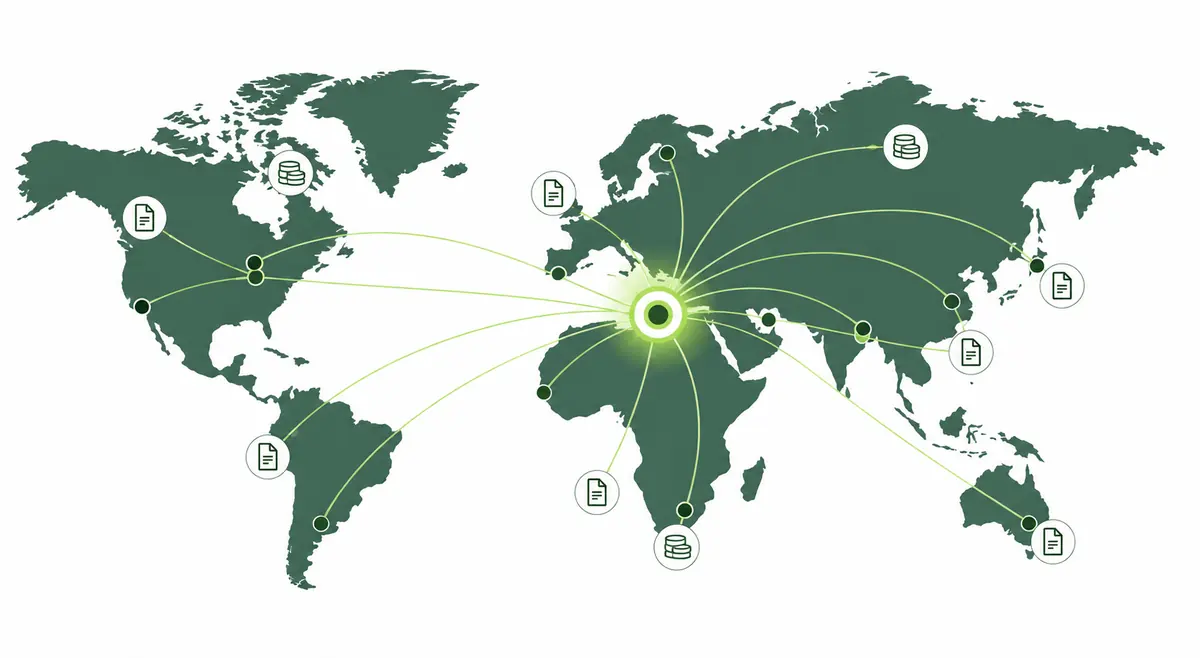
Cyprus has signed over 65 double tax treaties (DTTs), making it one of the most treaty-connected jurisdictions in the EU. For businesses routing cross-border income through a Cyprus holding company, these treaties can significantly reduce withholding taxes on dividends, interest, and royalties paid from subsidiary countries to Cyprus. The benefit is not automatic – substance requirements and anti-abuse rules must be satisfied.
What Double Tax Treaties Do
A double tax treaty is a bilateral agreement between two countries that determines which country has the right to tax specific categories of income, and at what rate. Without a treaty, the same income can be taxed in full in both the country where it arises and the country of the recipient’s residence – an outcome that makes cross-border investment structurally inefficient.
DTTs resolve this by:
- Allocating taxing rights – determining whether source or residence country taxes a given income type
- Reducing withholding tax rates – capping the tax a source country can deduct before remitting dividends, interest, or royalties
- Providing relief mechanisms – credit or exemption methods so the same income is not taxed twice
Cyprus’s domestic tax system compounds these treaty benefits. Under Cypriot law, dividends received by a Cyprus holding company from a foreign subsidiary are generally exempt from corporate income tax, provided the participation exemption conditions are met. When incoming dividends are already low-taxed at source due to a treaty, the effective cost of routing profits through Cyprus becomes very low.
The Treaty Network: Key Partners
Cyprus has treaties in force with over 65 countries, including the following strategically significant partners:
- United Kingdom – long-standing treaty, relevant for UK-Cyprus group structures
- Germany – one of the most commercially used, given the volume of German inbound investment
- India – historically significant; modified by MLI provisions, relevant for Indian promoters holding Cypriot entities
- UAE – important for Gulf-based investors with European operations routed through Cyprus
- Russia – treaty suspended since 2023; businesses relying on this structure should seek updated advice
- Netherlands, France, Italy, Poland, Hungary, Romania – all in force; broad EU coverage
The absence of a treaty with a particular country does not make a Cyprus structure impossible, but it removes the withholding tax reduction benefit and shifts the analysis to domestic exemptions and EU Directives such as the Parent-Subsidiary Directive for EU subsidiaries.
How Withholding Tax Reduction Works in Practice
When a foreign subsidiary pays a dividend to its Cyprus parent, the source country typically deducts withholding tax before remitting. The treaty rate replaces the domestic rate.
Worked Example – German Subsidiary Paying Dividends to Cyprus Holding:
Germany’s domestic withholding tax on dividends paid to foreign shareholders is 25% (plus solidarity surcharge), making the effective rate approximately 26.375%.
Under the Cyprus-Germany double tax treaty, and where the Cyprus company holds a qualifying stake, the withholding tax on dividends can reduce to 5%.
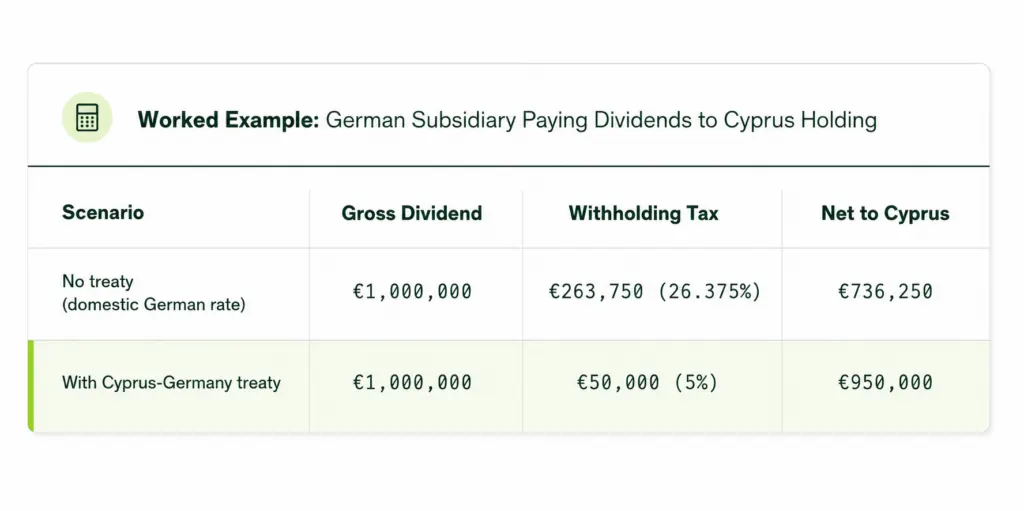
This difference of over €213,000 on a €1M dividend demonstrates why treaty access is a central consideration when structuring European holdings.
Withholding rates vary by treaty and are often conditional on ownership thresholds such as a 10% or 25% minimum shareholding. Always verify the specific treaty article and any MLI modifications before relying on a particular rate.
The same logic applies to interest and royalties. A Cyprus company receiving royalties from a German subsidiary may access reduced withholding rates on those payments, which combines powerfully with Cyprus’s IP Box regime – where qualifying IP profits face an effective tax rate of 3%.
Substance Requirements: The Anti-Treaty Shopping Framework
Treaty benefits are not available to shell entities. Both OECD standards (BEPS Action Plans) and Cyprus’s own tax legislation require that a company claiming treaty protection demonstrate genuine economic substance in Cyprus.
The Multilateral Instrument (MLI), which Cyprus has signed, introduces a Principal Purpose Test (PPT) into most of Cyprus’s treaties. Under the PPT, treaty benefits can be denied if one of the principal purposes of a transaction or arrangement was to obtain those benefits – unless granting them is consistent with the object and purpose of the treaty provision.
To withstand PPT scrutiny, a Cyprus holding company should have:
- A registered office with genuine operations – not just a postal address
- Local directors – at least a majority of directors resident in Cyprus, who actively participate in decision-making
- Board minutes – evidencing that key decisions such as investment approvals, dividend declarations, and funding decisions are made in Cyprus
- Staff or management presence – proportionate to the volume and complexity of income being managed
- Bank accounts operated locally
The level of substance required is proportionate to the complexity and value of the income flows being managed. A pure holding company with one underlying investment requires less infrastructure than a regional treasury or IP holding vehicle.
Limitation on Benefits vs Principal Purpose Test
Some treaties use a Limitation on Benefits (LOB) clause, which applies a more mechanical test: only entities meeting specific ownership and activity criteria qualify. The PPT is the more common approach in Cyprus’s treaty network following the MLI.
For groups subject to OECD Pillar Two – the global minimum tax applying to groups with revenues above €750 million – treaty planning and substance must be evaluated in conjunction with the GloBE rules. For groups below this threshold, the existing Cyprus treaty network and domestic exemptions remain fully operative.
Practical Implications for Holding Structures
A well-constructed Cyprus holding structure can achieve:
- Reduced withholding tax at the source subsidiary level via treaty
- Participation exemption at the Cyprus level – dividends received are often exempt from Cyprus corporate tax
- Low or zero tax on exit – capital gains from disposal of shares in subsidiaries are generally exempt from Cyprus corporate tax, subject to conditions
- Efficient profit repatriation – dividends paid by the Cyprus company to non-domiciled shareholders are exempt from Special Defence Contribution (SDC)
These layers combine to make Cyprus a structurally efficient location for holding cross-border investments – provided substance is genuine and the structure is designed before transactions are executed.
For tailored advice on Cyprus double tax treaties and holding company structures, contact us and we will be happy to help you.
This article is general information on Cyprus tax rules, not advice on your position. The right answer depends on your structure, your residency and the type of income, so treat it as the start of a conversation rather than the end of one.