Cyprus IP Box Regime: How to Qualify for the 3% Effective Tax Rate on IP Income
Cyprus's IP Box regime delivers an effective 3% tax rate on qualifying IP income through an 80% profit exemption. Here's how to qualify and which businesses benefit most.
Written by Andreas AchilleosFinancial Advisory Lead · CFA Charterholder


The Cyprus IP Box regime provides an 80% exemption on qualifying profits derived from eligible intellectual property – delivering an effective tax rate of 3% on those profits under the 2026 corporate tax rate of 15%. For technology companies, SaaS businesses, pharmaceutical groups, and any business whose value sits in intangible assets, it remains one of the most competitive IP tax regimes in the European Union.
How the 3% Rate Is Calculated
The IP Box works through an income exemption, not a reduced rate. Of the qualifying profit generated from eligible IP, 80% is excluded from taxable income. Only 20% is subject to the standard corporate income tax rate.
With the corporate tax rate at 15% from 1 January 2026:
20% × 15% = 3% effective rate on qualifying IP income
This is a modest increase from the pre-2026 position, when the same 80% exemption applied against the old 12.5% rate, giving an effective rate of 2.5%. The regime itself is unchanged – the slightly higher effective rate reflects the corporate tax increase.
What IP Qualifies
The Cyprus IP Box follows the OECD’s nexus approach, which means qualifying assets must be tied to qualifying expenditure incurred by the Cyprus entity. The eligible asset categories are:
- Patents – granted or pending, covering technical inventions
- Software copyrights – including proprietary software developed for commercial use or licensing
- Know-how and trade secrets – where legally protected and not generally known
- Other intangible assets – meeting the OECD nexus criteria, excluding marketing-related intangibles such as trademarks and brand names
Trademarks, brand value, and marketing intangibles do not qualify. This is a deliberate OECD design feature to limit the regime to productive R&D-linked assets.
What Income Qualifies
The regime applies to qualifying profits, not gross revenues. Qualifying income streams include:
- Licensing and royalty income – fees received for granting the right to use qualifying IP
- Embedded IP income – where qualifying IP is incorporated into a product or service sold commercially, a notional royalty can be extracted and subjected to the IP Box
- Gains on disposal of qualifying IP – where the IP is sold, the gain may qualify
- Income from qualifying IP used in the company’s own products/services – where the formula allocating the IP contribution can be substantiated
The Nexus Approach: What It Means for Structure
To access the IP Box, the qualifying expenditure that created the IP must have been incurred by the Cyprus company itself. The nexus fraction determines the proportion of income that qualifies:
Qualifying fraction = (Qualifying expenditure × 1.3) / Overall expenditure
- Qualifying expenditure: R&D costs incurred directly by the Cyprus company, or contracted out to unrelated third parties
- Non-qualifying expenditure: costs paid to related parties, or costs of acquiring the IP from a third party
The 1.3 uplift factor allows some related-party R&D costs to be included, up to 30% of qualifying expenditure.
In practice, this means a Cyprus company that conducts meaningful R&D activity – either internally or through arm’s length contractors – can access the full regime. A company that merely holds IP developed entirely by related parties in other jurisdictions will have a lower qualifying fraction and therefore lower IP Box benefit.
Worked Example: SaaS Business
A Cyprus SaaS company earns €1,000,000 in annual software licensing revenue. The software was developed by the company’s own engineering team in Cyprus. All R&D expenditure was incurred by the Cyprus entity.
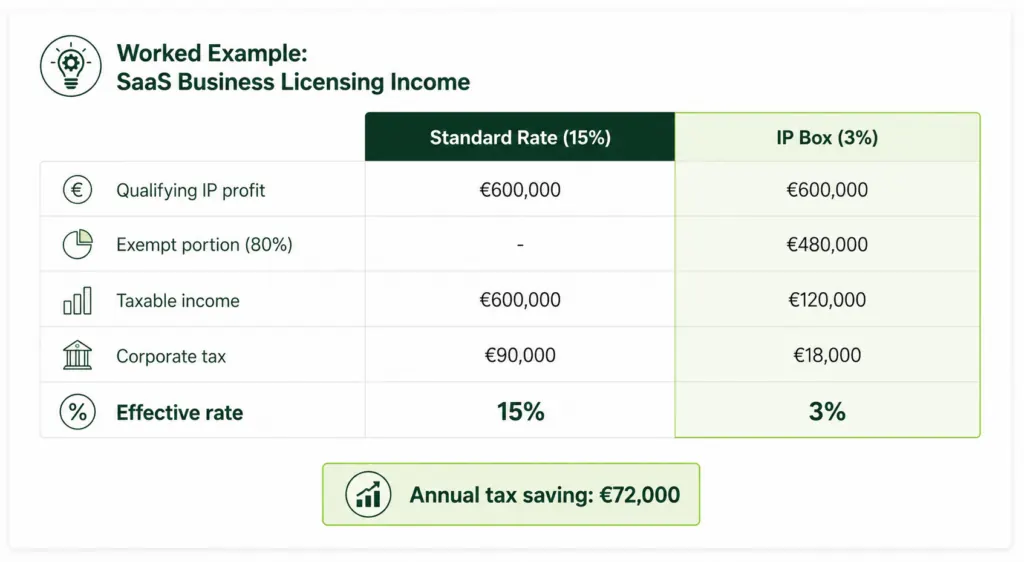
For comparison, the same €600,000 of licensing profit in Germany would attract corporate tax and trade tax at a combined effective rate of approximately 30%, resulting in a tax bill of around €180,000 – a gap that echoes the withholding tax differential we explored in our article on Cyprus double tax treaties, where Germany again featured as the higher-tax comparator.
Interaction with the R&D Super-Deduction
The 120% R&D super-deduction available until 31 December 2030 is designed to complement the IP Box. The combination works as follows:
- The Cyprus company incurs qualifying R&D expenditure to develop IP
- The super-deduction reduces taxable income by 120% of that spend – a €100,000 R&D cost generates a €120,000 deduction
- The IP developed is then exploited – licensed or embedded in products – under the IP Box
- The licensing income attracts the 3% effective rate
This two-stage structure – develop under super-deduction, exploit under IP Box – is one of the most tax-efficient IP strategies available within the EU.
Does the IP Box Survive Pillar Two?
For multinational groups with consolidated global revenue below €750 million, Pillar Two does not apply. The IP Box continues to deliver a 3% effective rate without restriction.
For groups above the €750 million threshold, Pillar Two requires a minimum effective tax rate of 15% globally – the same headline rate discussed in our piece on Cyprus’s 15% corporate tax. The IP Box delivers an effective rate of 3% on qualifying income, which is below the Pillar Two floor. However, the Substance-Based Income Exclusion (SBIE) may offset some of the top-up exposure where the Cyprus entity has genuine payroll and tangible assets.
The vast majority of businesses using the Cyprus IP Box operate below the Pillar Two threshold and are not affected.
Substance Requirements
The Cyprus IP Box is OECD/BEPS compliant. To access it, the Cyprus company must demonstrate:
- Real economic activity and decision-making in Cyprus
- R&D functions performed in Cyprus or contracted to unrelated parties
- Adequate staff, infrastructure, and management presence
- Proper documentation of the IP development process, cost allocation, and licensing arrangements
Cyprus does not have a substance-light IP holding regime. The IP Box is available to companies conducting genuine R&D and IP exploitation activity from Cyprus.
Who Should Consider the IP Box
The IP Box is most relevant for:
- SaaS and software companies where the core asset is proprietary software
- Technology companies with patent-protected products or processes
- Pharmaceutical and life sciences groups with patent portfolios
- Businesses with licensable know-how or trade secrets
- Groups restructuring IP ownership as part of a Cyprus holding or operational structure
It is less relevant for businesses whose revenue is derived from services, distribution, or brand value rather than legally protected technical IP.
For tailored advice on structuring your IP through Cyprus and qualifying for the 3% effective rate, contact us either through telephone, email or our website.
This article is general information on Cyprus tax rules, not advice on your position. The right answer depends on your structure, your residency and the type of income, so treat it as the start of a conversation rather than the end of one.