Crypto Gains Tax in Cyprus 2026: The 8% Rate, What It Covers, and What It Doesn’t
Cyprus introduced an 8% flat tax on individual crypto capital gains from January 2026. Find out what it covers, what it doesn't, and how it compares to the UK and Germany.
Written by Andreas AchilleosFinancial Advisory Lead · CFA Charterholder


From 1 January 2026, Cyprus imposes a flat 8% tax on capital gains from cryptocurrency disposals by individual taxpayers. This is the first time Cyprus has introduced specific legislation governing the taxation of crypto assets for individuals – previously, there was no clear statutory framework, creating significant uncertainty. For corporate entities, gains from crypto assets are taxed at the standard corporate income tax rate of 15%.
The Previous Position: No Specific Legislation
Until the end of 2025, Cyprus had no dedicated legislation dealing with individual gains from cryptocurrency. The Cyprus Tax Department had not issued definitive guidance on whether crypto gains constituted capital gains, income, or fell outside the tax net entirely. In practice, many individual investors treated crypto gains as outside the scope of Cyprus taxation, but this position carried legal risk.
The introduction of an 8% flat rate resolves this ambiguity. It creates a defined, relatively low tax charge for individuals and removes the uncertainty that previously made tax planning around crypto assets in Cyprus difficult to execute with confidence.
What the 8% Rate Covers
Qualifying Assets
The legislation adopts a broad definition of crypto assets. Assets that fall within scope include:
- Bitcoin (BTC) and Ethereum (ETH)
- Other fungible tokens traded on exchanges
- Utility tokens and governance tokens meeting the definition of a crypto asset
- Stablecoins (where a disposal event is triggered)
The definition tracks broadly with the EU’s MiCA (Markets in Crypto-Assets) Regulation framework, which Cyprus is implementing as an EU member state.
Qualifying Disposal Events
The 8% rate applies on realisation – that is, when a taxable disposal occurs. Disposal events include:
- Sale of crypto for fiat currency – converting BTC or any token to euros, US dollars, or any other fiat
- Exchange of one crypto for another – swapping ETH for BTC, or any token-to-token trade, constitutes a disposal of the first asset
- Use of crypto as payment – paying for goods or services using crypto triggers a disposal at the value of the transaction at the date of payment
The gain is calculated as the disposal proceeds less the original cost basis (acquisition price). Where multiple acquisitions have been made at different prices, specific identification or weighted average cost basis methods may apply – taxpayers should maintain detailed records of acquisition dates and prices.
Dealing with crypto or corporate tax in Cyprus? Fiscalpoint handles Cyprus corporate tax & compliance for companies and investors. Book a consultation →
What the 8% Rate Does Not Clearly Cover
Certain areas remain subject to pending guidance from the Cyprus Tax Department:
DeFi Transactions
Decentralised finance activity – including providing liquidity to automated market makers, yield farming, and participation in lending protocols – raises complex questions about when a disposal event occurs. Whether depositing tokens into a liquidity pool constitutes a disposal of those tokens, and whether receiving LP tokens constitutes an acquisition at market value, has not been definitively addressed in the new legislation. Taxpayers with significant DeFi activity should seek specific advice and maintain full transaction logs.
Staking Rewards
The treatment of staking rewards is unsettled. Two possible positions exist: rewards could be treated as income at the point of receipt (taxable as miscellaneous income under ordinary income tax rates) or treated as a new asset with a zero cost base that becomes subject to the 8% flat rate only on subsequent disposal. The legislation does not resolve this clearly, and guidance is awaited.
NFTs
Non-fungible tokens present further complexity. Where an NFT is held as an investment asset and sold at a gain, the 8% flat rate may apply. Where NFT creation and sale constitutes a trade or business activity, ordinary income tax rates could apply instead. The distinction matters significantly given the top personal income tax rate of 35%.
Reporting Requirements
Individual taxpayers with crypto gains must declare these in their annual personal income tax return filed with the Cyprus Tax Department. The gain is reported separately and taxed at the flat 8% rate, not aggregated with other income for the purposes of progressive rate bands.
Taxpayers are required to maintain records sufficient to support the calculation of gains, including:
- Acquisition dates and prices for each asset
- Disposal dates and proceeds
- Exchange transaction logs or wallet records
- Conversion rates used where proceeds were received in another crypto asset
Failure to declare crypto gains carries the same penalty regime as other undeclared income.
Corporate Crypto: Standard 15% CIT Applies
Companies holding or trading crypto assets are taxed on gains at the standard corporate income tax rate of 15% (effective from 1 January 2026, increased from 12.5%). There is no flat rate concession for corporate entities – gains form part of taxable trading income or are treated as chargeable gains depending on the nature of the activity.
For corporate treasury or investment structures, the 8% individual rate creates a clear incentive for high-net-worth crypto investors to hold assets personally rather than through a company, provided they are Cypriot tax residents and the holding is genuinely personal investment rather than a business activity.
Comparison: Cyprus vs UK vs Germany
The 8% flat rate is materially competitive by European standards.
Worked Example – Individual Selling Crypto with €50,000 Gain:
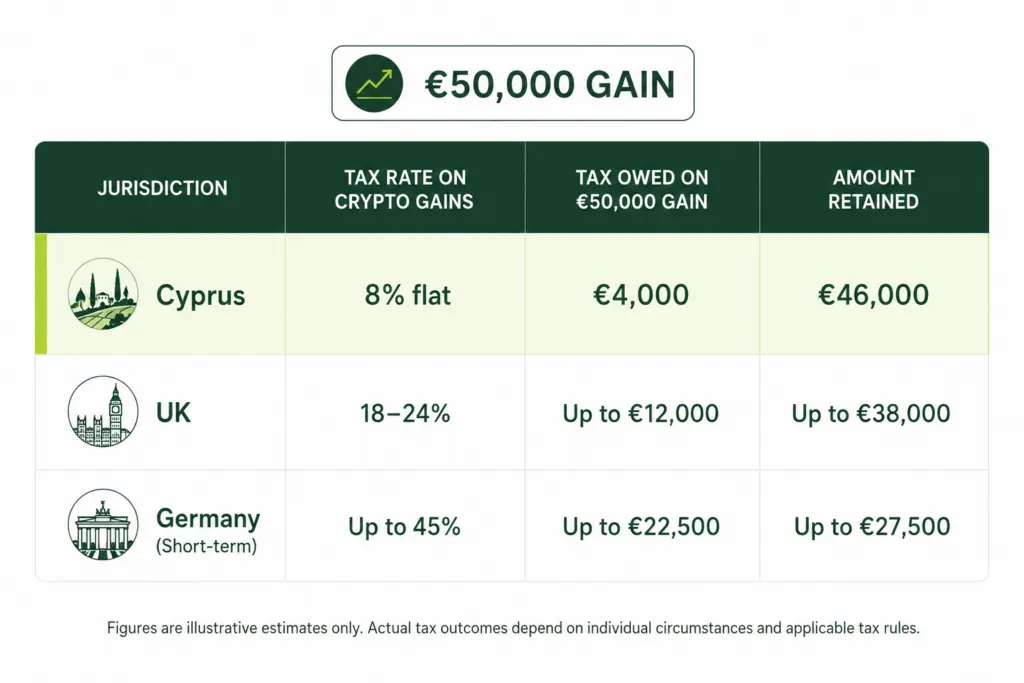
Germany: Short-term gains (held less than one year) are taxed at the individual’s marginal income tax rate, which can reach 45% plus solidarity surcharge. Gains from crypto held for more than one year are completely tax-free. There is also an annual exemption of €999 on private disposal gains.
United Kingdom: Capital gains tax on crypto applies at 18% (basic rate taxpayer) or 24% (higher rate taxpayer), with an annual exempt amount of £3,000.
For an individual with €50,000 in crypto gains, the Cypriot flat rate results in a tax charge of €4,000 – compared to up to €22,500 in Germany (short-term) and up to €12,000 in the UK.
What This Means for Crypto Investors Considering Cyprus Residency
The introduction of a defined 8% flat rate, combined with Cyprus’s broader tax advantages, makes the jurisdiction meaningfully attractive for high-net-worth crypto investors. Key considerations for relocation planning include:
- Tax residency: An individual must become a Cyprus tax resident (present for 183 days, or 60 days under the non-dom 60-day rule) for Cyprus tax rates to apply
- Non-dom status: Non-domiciled residents are exempt from Special Defence Contribution on dividends, interest, and rental income – adding further efficiency on investment income beyond crypto
- Timing of disposals: Gains realised after establishing Cyprus tax residency fall under the 8% rate; gains realised before relocation are governed by the previous jurisdiction’s rules
- Exit taxation: Some EU jurisdictions impose exit taxes on unrealised gains when an individual ceases tax residency – professional advice in the country of departure is essential before relocating
The 8% rate does not apply automatically to historical gains accrued in another jurisdiction and simply realised after moving to Cyprus. The interaction between accrual dates, residency, and treaty provisions requires careful analysis.
This article is general information on Cyprus tax rules, not advice on your position. The right answer depends on your structure, your residency and the type of income, so treat it as the start of a conversation rather than the end of one.