Cyprus Provisional tax: How the System Works, When to Revise, and How to Avoid Overpaying
Cyprus provisional tax is paid in two instalments - 31 July and 31 December. Learn how to calculate your estimate, use the December revision window, and avoid the 10% underpayment penalty.
Written by Robert LondonAudit & Accounting Lead · ACA (ICAEW) · ICPAC practising certificate

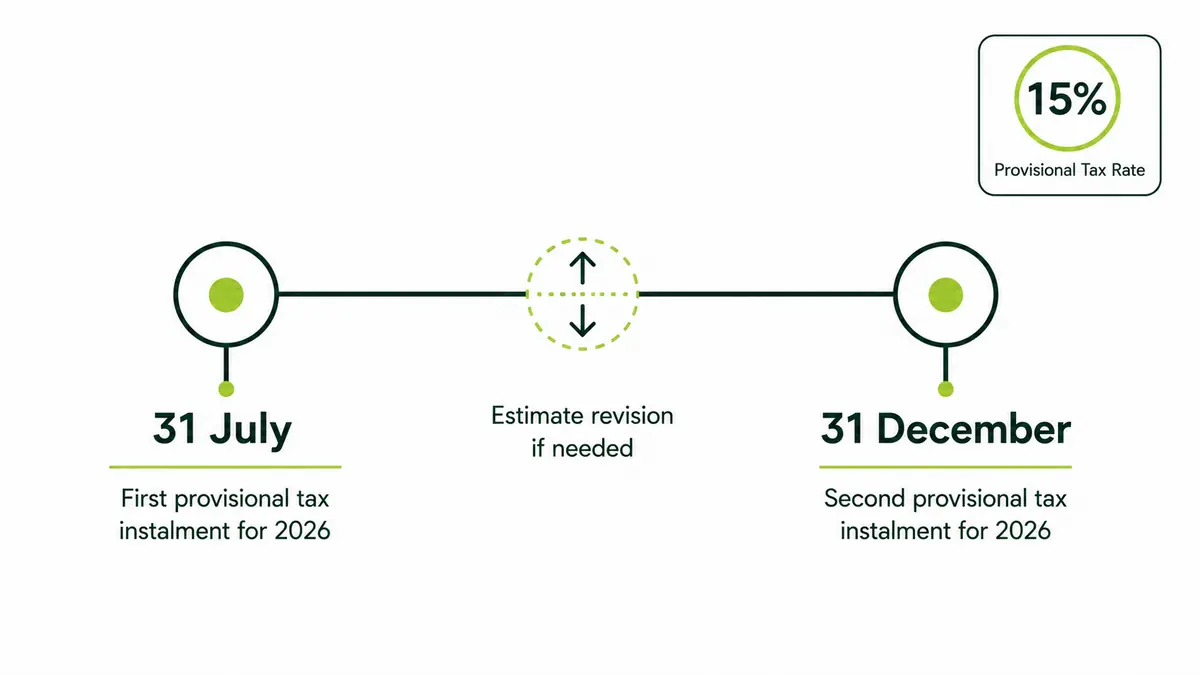
Provisional tax is Cyprus’s advance payment system for corporate and personal income tax – companies and self-employed individuals pay estimated tax during the year rather than settling the full liability after the fact. The system contains a meaningful penalty for significant underpayment, but also a valuable revision window that most businesses underuse.
The system sits within a significantly reformed 2026 tax framework – for a full overview see our Cyprus Tax Reform 2026 summary (Cyprus tax reforms).
What Is Provisional Tax
Provisional tax is an advance payment of income tax based on an estimate of the current year’s taxable income. It applies to:
- Cyprus tax-resident companies – based on estimated corporate taxable income for the year
- Self-employed individuals – based on estimated personal taxable income for the year
The estimate is made by the taxpayer. There is no prescribed minimum – you assess what you expect to earn and pay accordingly. However, getting the estimate materially wrong in one direction carries a penalty.
Two instalments
Provisional tax is paid in two equal instalments:
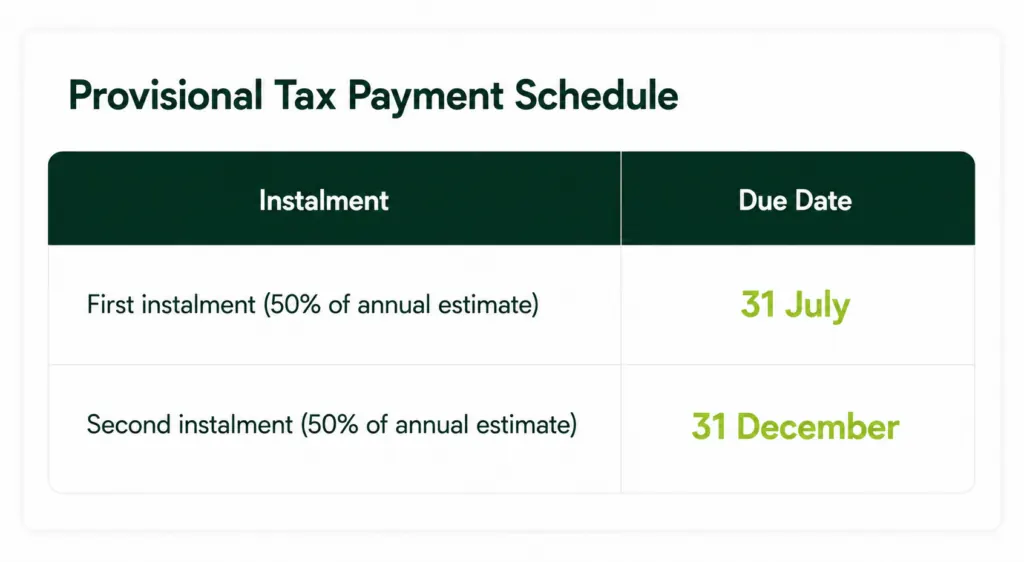
Both instalments are based on the same annual estimate. If you estimate annual taxable income of EUR200,000 and corporate tax at 15% = EUR30,000, each instalment is EUR15,000.
For a full overview of all obligations due on 31 July, see our Cyprus tax deadlines July 2026 guide (Tax deadlines).
The undepayment penalty
If the actual tax liability for the year turns out to be more than 25% higher than the provisional tax paid, a 10% penalty is imposed on the shortfall between the provisional amount and the actual liability.
How the Penalty Works
Example:
- Estimated taxable income: EUR200,000 → Provisional tax declared: EUR30,000
- Actual taxable income for the year: EUR350,000 → Actual tax: EUR52,500
- Provisional tax paid: EUR30,000
- Shortfall: EUR22,500
- Does the shortfall exceed 25% of actual tax? EUR52,500 x 25% = EUR13,125. Yes – the shortfall of EUR22,500 exceeds this.
- Penalty: 10% x EUR22,500 = EUR2,250
The penalty is in addition to the tax itself, which must still be paid in full.
If the actual tax was EUR36,000 instead, the shortfall of EUR6,000 would be only 16.7% of actual tax – below the 25% threshold – and no penalty would apply.
The December Revision Window
This is the most important planning tool in the provisional tax system and is widely underused.
Before 31 December – specifically before the second instalment deadline – a taxpayer can revise their provisional tax estimate downward (or upward). The revised figure then becomes the basis for assessing whether the underpayment penalty applies.
Why This Matters
If your business has had a weak year and your actual profits will be significantly lower than your original estimate, you can reduce your provisional tax declaration before 31 December. This:
- Reduces the second instalment payment due on 31 December
- Reduces the total provisional tax paid, aligning it with actual performance
- Ensures any overpayment is not excessive
The revision must be made before the second instalment deadline. Once 31 December has passed without a revision, the original estimate stands for the purpose of the penalty calculation.
Avoiding Overpayment
Overpaying provisional tax is not costless. While overpayments are refunded after the final tax assessment, the refund process takes time – often months. In the meantime, the business has parted with cash it could have deployed elsewhere.
Practical Steps to Avoid Overpayment
- Base your estimate on realistic current-year projections. Use management accounts at the mid-year point to assess whether your original estimate is still accurate.
- Review before 31 December. If actual profits are tracking below estimate, file a revised declaration before the second instalment due date. Adjust the second payment accordingly.
- Don’t confuse provisional tax with prior-year tax. Provisional tax is always based on the current year’s estimate – it is not simply last year’s actual liability repeated.
- Model the 25% threshold. If actual profits are uncertain, calculate what level of actual tax would trigger the penalty given your current estimate.
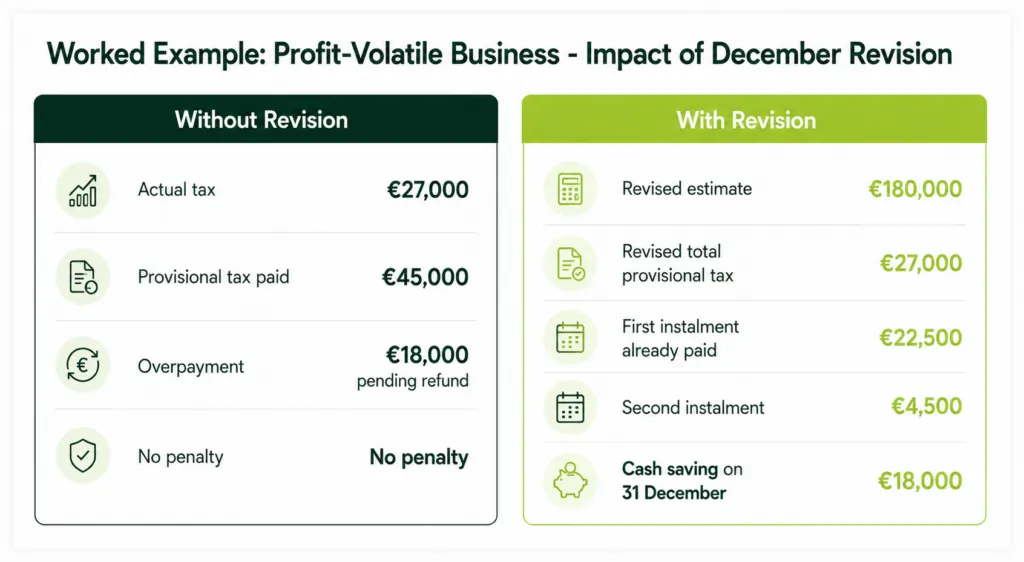
Worked Example: Profit-Volatile Business
A Cyprus trading company made €400,000 profit in 2025. For 2026, the directors estimate €300,000 profit.
- Provisional tax declared: €300,000 x 15% = €45,000
- First instalment (31 July): €22,500
- Second instalment (31 December): €22,500
By November, management accounts show the business is on track for only €180,000 profit.
Without Revision
- Actual tax: €180,000 x 15% = €27,000
- Provisional tax paid: €45,000
- Overpayment: €18,000 – refund pending after final assessment
- No penalty applies – actual tax is below provisional paid
With Revision (before 31 December)
- Revised estimate: €180,000 → revised total provisional tax: €27,000
- First instalment already paid: €22,500
- Second instalment (revised): €4,500 (not €22,500)
- Cash saving on 31 December: €18,000 retained in the business rather than advanced to the Tax Department
Overpayment and refunds
Where provisional tax paid exceeds the final tax liability, the excess is refunded after the final corporate tax return is assessed. The refund process requires submission of the annual return, assessment by the Tax Department, and payment of any outstanding balance or issue of the refund.
Businesses with consistently lower actual profits than provisional estimates should review their estimation methodology. Persistent overpayment represents an interest-free loan to the Tax Department.
Interaction with the 2026 Corporate Tax Rate
The increase in the corporate tax rate from 12.5% to 15% (New corporate tax rate) from 1 January 2026 means provisional tax payments for the 2026 tax year are calculated on the new 15% rate. Businesses that use prior-year tax as a starting point for their estimate must adjust upward to account for the rate change, even where profits are stable.
A company with EUR500,000 taxable profit in both 2025 and 2026:
- 2025 actual tax: EUR62,500 (at 12.5%)
- 2026 provisional tax estimate: should be EUR75,000 (at 15%) – not EUR62,500
Using the old rate as a baseline for the 2026 provisional estimate would create a shortfall of EUR12,500. Whether this triggers the underpayment penalty depends on the 25% threshold calculation.
For tailored advice on provisional tax planning and the December revision process, contact Fiscalpoint at fiscalpoint.com.
This article is general information on Cyprus tax rules, not advice on your position. The right answer depends on your structure, your residency and the type of income, so treat it as the start of a conversation rather than the end of one.