Cyprus tax deadlines: july 2026
July is the most deadline-intensive month in the Cyprus tax calendar. Provisional tax, VAT, VIES, PAYE, and the annual TD7 employer return all fall due. Here's what you need to prepare.
Written by Robert LondonAudit & Accounting Lead · ACA (ICAEW) · ICPAC practising certificate

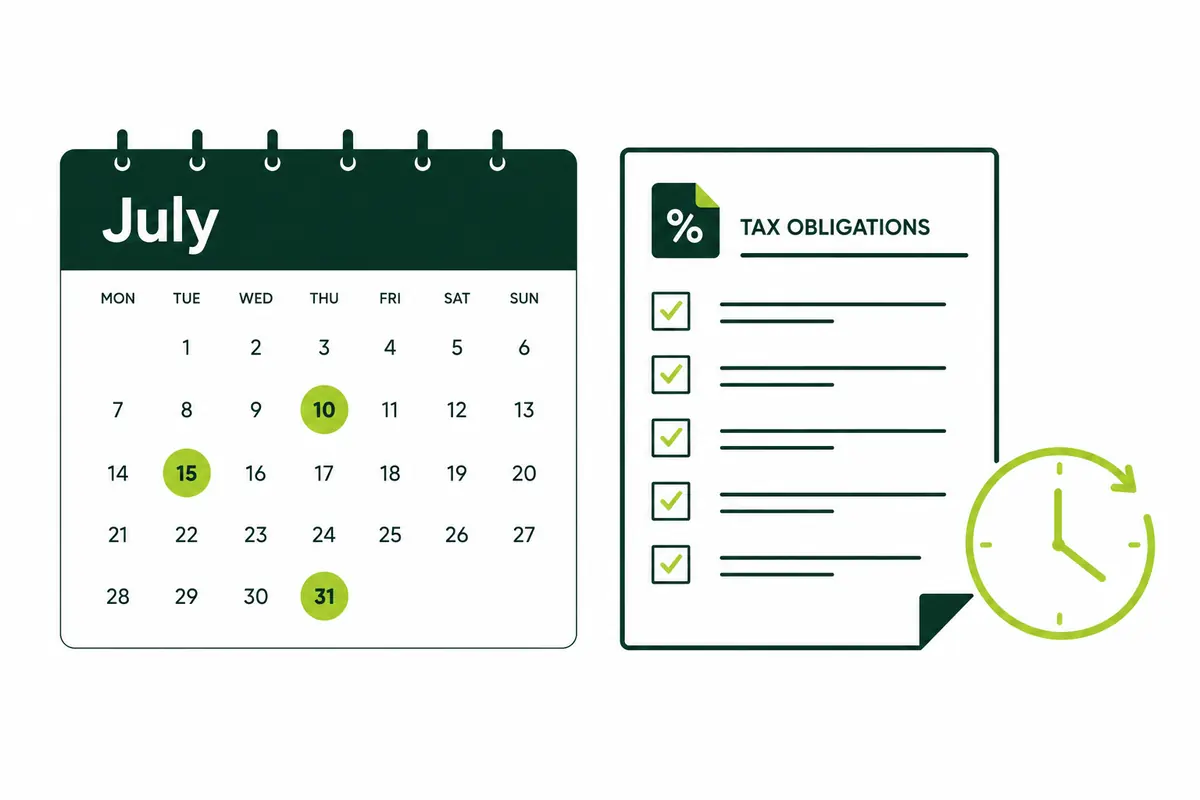
July is the most deadline-intensive month in the Cyprus tax calendar. Within a single month, businesses face a provisional tax instalment, multiple VAT and VIES filing dates, monthly payroll obligations, and the annual employer return. Missing any one of these triggers penalties that apply from day one. This article sets out every July 2026 deadlines, what it covers, and what businesses need to prepare.
These obligations sit within a significantly reformed tax framework – for a full overview of the 2026 changes, see our Cyprus Tax Reform 2026 summary.
Overview: July 2026 Deadlines at a Glance
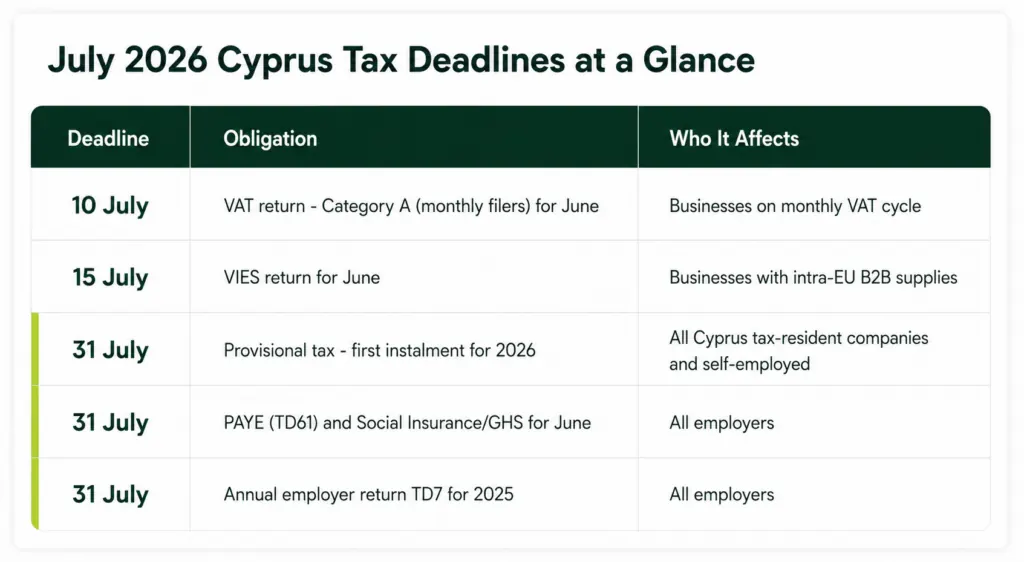
10 July - VAT Return (Category A: Monthly Filers)
Businesses assigned to VAT Category A file monthly VAT returns. The return for June 2026 – and payment of any net VAT liability – is due by 10 July 2026.
Category A filers are typically larger businesses or those with a consistent net payable position. Assignment to Category A is made by the Tax Department and is not a choice available to most businesses.
What to prepare:
- Reconcile output VAT (sales) and input VAT (purchases) for June
- Identify any correction entries from prior months
- Confirm bank payment has been initiated in time to clear by the 10th
15 July - VIES Return for June
Any Cyprus VAT-registered business that makes supplies of goods or services to VAT-registered businesses in other EU member states must submit a VIES (VAT Information Exchange System) return. The VIES return for June is due by 15 July 2026.
VIES is separate from the VAT return. It is a summary of the total value of intra-Community supplies made to each EU customer in the period, identified by their EU VAT number.
Common errors:
- Omitting B2B service supplies (not just goods)
- Incorrect EU VAT numbers for customers
- Submitting VIES late because it is treated as less urgent than the VAT return – the penalty regime applies equally
31 July - Provisional Tax: First Instalment for 2026
The first of two provisional tax instalments for the 2026 tax year is due on 31 July 2026.
Provisional tax is an advance payment of corporate income tax (or personal income tax for self-employed individuals) based on an estimate of the current year’s taxable income. The first instalment represents 50% of the total provisional tax declared for the year.
How to Calculate the Instalment
- Estimate taxable income for the full 2026 calendar year
- Apply the relevant tax rate (15% for companies; progressive bands for individuals)
- Divide by 2 – this is the first instalment due on 31 July
Example: A company estimates 2026 taxable income of €250,000.
- Provisional tax: €250,000 × 15% = €37,500
- First instalment: €18,750 due by 31 July
The Penalty for Underpayment
If the annual provisional tax declared is more than 25% below the actual tax liability for the year, a 10% penalty applies on the shortfall. Setting a reasonable estimate at this stage protects against that penalty.
The December Revision Right
If performance changes materially during the year, the annual estimate – and therefore the second instalment – can be revised before 31 December. The July instalment cannot be revised retrospectively, but there is no penalty for paying too much. Paying too little (more than 25% below actual) is what triggers the penalty.
31 July - PAYE (TD61) and Employer Social Insurance / GHS for June
Every employer must remit the following by 31 July 2026 in respect of the June payroll:
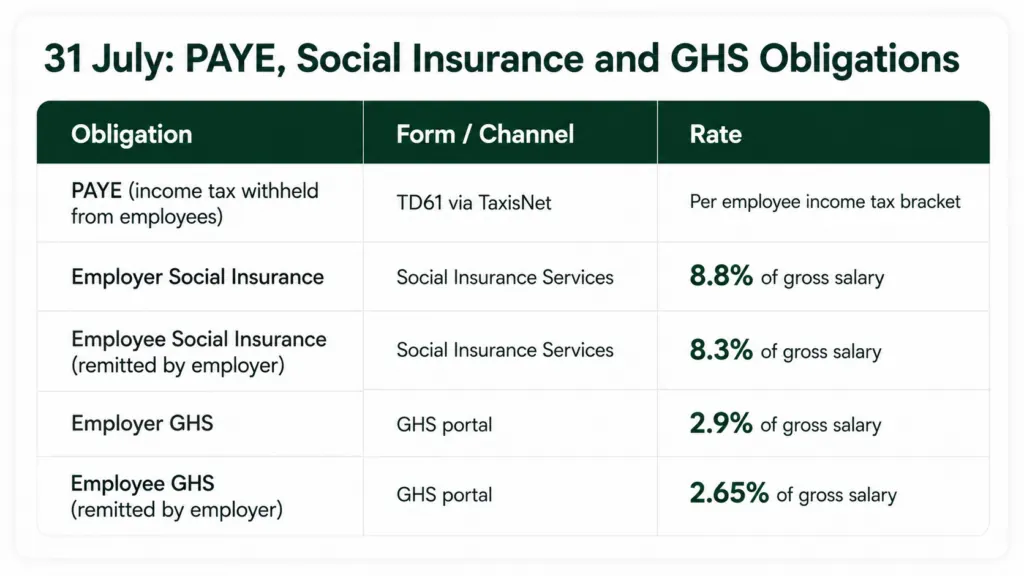
All four obligations share the same end-of-month deadline. The most common mistake is completing the TD61 PAYE submission but delaying the Social Insurance payment – both must be settled by month end.
31 July - Annual Employer Return TD7 for 2025
The TD7 is the annual employer return summarising all remuneration paid to each employee during the 2025 tax year, together with the total PAYE withheld. It is due by 31 July 2026.
The TD7 is filed through TaxisNet and is separate from the monthly TD61 submissions. It serves as the definitive record of employer-withheld tax and is used by the Tax Department to cross-check individual employee tax positions.
What the TD7 Must Include
- Each employee’s full name, tax identification number (TIC), and total gross remuneration for 2025
- Total PAYE withheld per employee during the year
- Any benefits in kind provided (company car, housing, etc.)
- Details of termination payments where applicable
Penalty for late TD7: Administrative penalties apply from the day after the deadline. Where the TD7 reveals discrepancies against the monthly TD61 submissions, the Tax Department may raise assessments for any shortfall plus interest.
Preparing for July: A Practical Checklist
By mid-June (for 10 July VAT deadline):
- Begin reconciling June VAT input and output
- Identify any invoices to be issued before month-end that affect the June VAT position
- Confirm Category A filing status if uncertain
By end of June (for 15 July VIES deadline):
- Compile all intra-EU B2B sales for June
- Verify EU VAT numbers for each customer
By mid-July (for 31 July deadlines):
- Run year-to-date management accounts to support provisional tax estimate
- Calculate first provisional tax instalment and ensure payment is initiated with sufficient time to clear
- Process June payroll, calculate PAYE, SI, and GHS, and initiate payments
- Begin compiling TD7 data for 2025 – total remuneration and PAYE per employee
Before 31 July:
- Submit TD61 for June payroll
- Pay Social Insurance and GHS for June
- File provisional tax declaration and pay first instalment
- Submit TD7 annual employer return
What Happens If You Miss a July Deadline
Penalties for late filing and payment in Cyprus apply from day one – there is no grace period. The applicable penalty and interest rates vary by obligation:
- Provisional tax: Interest accrues on late payment; the 10% underpayment penalty applies at year-end if provisional tax is materially below actual liability
- PAYE and SI/GHS: Administrative penalties and interest apply; late Social Insurance contributions also affect employee benefit entitlements
- VAT and VIES: Penalty and interest per the VAT legislation; persistent late VIES submission can trigger Tax Department scrutiny
The cost of missing these deadlines is always higher than the cost of preparing for them. July’s concentration of obligations is predictable – it is the same every year. Businesses that plan for it in May and June are never scrambling in the last week of July.
For reference on how the earlier part of the 2026 tax calendar was structured, see our April 2026 tax deadlines guide.
For support with July tax deadlines, provisional tax planning, and payroll compliance, contact Fiscalpoint at fiscalpoint.com
This article is general information on Cyprus tax rules, not advice on your position. The right answer depends on your structure, your residency and the type of income, so treat it as the start of a conversation rather than the end of one.