TD59 form Cyprus – 2026
Learn how to complete the TD59 form Cyprus 2026, who must submit it, and why it matters for PAYE payroll tax compliance in Cyprus.
Written by Robert LondonAudit & Accounting Lead · ACA (ICAEW) · ICPAC practising certificate


TD59 Form Cyprus 2026: How Employees Should Complete the Annual Tax Declaration
The TD59 form Cyprus 2026 is an annual employee tax declaration that must be completed and submitted to employers at the beginning of each calendar year. The form allows employers to calculate PAYE income tax deductions correctly, based on the employee’s tax residency status, allowances, and expected deductions for the year.
Submitting an accurate TD59 form helps prevent over-taxation and ensures payroll compliance throughout the year.
PAYE, refers to the monthly deductions your employer makes from your salary relating to the tax payment made to the tax authorities, based on the best estimate of your annual income.
The TD59 form is issued by the Cyprus Tax Department and is used by employees to declare their personal tax details to their employer. It does not need to be filed directly with the Tax Department.
Employers rely on the TD59 to apply:
- Correct PAYE tax rates
- Applicable allowances and exemptions
- Accurate monthly payroll deductions
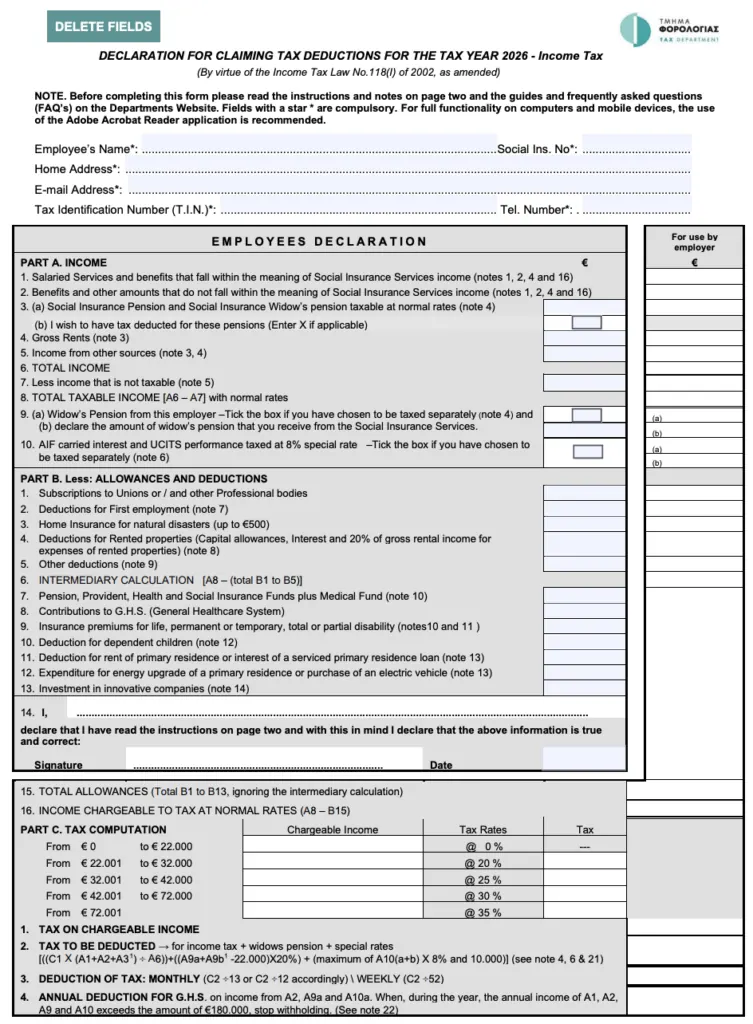
Above is an extract of the TD59 form. You can find it in this link:
https://www.gov.cy/mof-tfa/documents/tf59/
Who must complete TD59?
The TD59 must be completed by:
- All employees working in Cyprus
- New employees upon commencement of employment
- Existing employees at the start of each tax year
- Employees whose tax status or personal circumstances have changed
How to complete the form: Step-by-step guide
1. Personal details
Provide your:
- Full name
- Tax identification number
- Identity card or passport number
- Address and contact details
Ensure all information matches your official records with the Tax Department.
2. Employment information
State:
- Employer’s name
- Employer’s Tax Identification Code
- Start date of employment (if applicable)
3. Tax Residency Declaration
Indicate whether you are a Cyprus tax resident, or a non-resident. This is especially important for expatriates and relocated employees.
4. Allowances, Deductions & Exemptions
Declare any applicable reliefs, such as:
- Social insurance and pension contributions
- Approved life insurance premiums
- Provident fund contributions
- Special expatriate income tax exemptions (where applicable)
Only declare amounts you reasonably expect to incur during the year.
Note: Any bonus amounts expected to be received within the year, which are not contractual obligations of the employer, may not be included in the amount.
- At the beginning of each calendar year
- Upon commencement of employment
- When there is a change in tax status or personal circumstances
Note: Submit directly to your employer, not to the Tax Department.
What to state in the form:
- 20%/50% exemption (part B2): To claim the exemption, state the date of first arrival in Cyprus and for which percentage you are eligible for
- If you are claiming a deduction for first employment you are allowed to deduct either (a) 20% of emoluments (max €8,550), or (b) 50% of emoluments for any employment if your salary exceeds €100.000 (gross annually), or (c) 50% of emoluments provided your salary exceeds €55.000 (gross annually) in the tax year
- Personal insurance PART B7): Split the amounts between (1) Own personal life insurance (2) Private medical insurance (does not include employer’s group plans) and (3) any private pension plan contributions. Please indicate that it relates to to each category accordingly
- Income other than salary income: Include any other income (e.g., rental income, business income)
- Donations to registered charities (part B5)
- Subscriptions to unions and professional bodies (part B1): Include amounts such as ICPAC, CYSEC, ACA, ACCA and other amounts paid to such bodies
- Dependent student (up to 24y/o) / children deductions (part B10): €1.000 for first, €1.250 for second, €1.500 for third and above
- Housing deduction (part B11): Up to €2.000 interest on primary residence loans or rent expense for primary residence
- Green transition (part B12): Up to €1.000 for house energy upgrades or electric vehicle purchase
- House insurance: Up to €500 for house / natural disaster premiums
- Investment expenses in innovative business (part B13)
Note: You do not need to complete in the form Provident fund payments, or any other tax-deductible expenses (e.g., social insurance payments, GESY) since your payroll team should already know the amounts.
Need Assistance?
If you are unsure how to complete your TD59 or how allowances apply to your situation, professional advice can help ensure correct payroll taxation and compliance from the start of the year.
This article is general information on Cyprus tax rules, not advice on your position. The right answer depends on your structure, your residency and the type of income, so treat it as the start of a conversation rather than the end of one.